Cabins and Yurts in Texas State Parks: What the Rooms Include
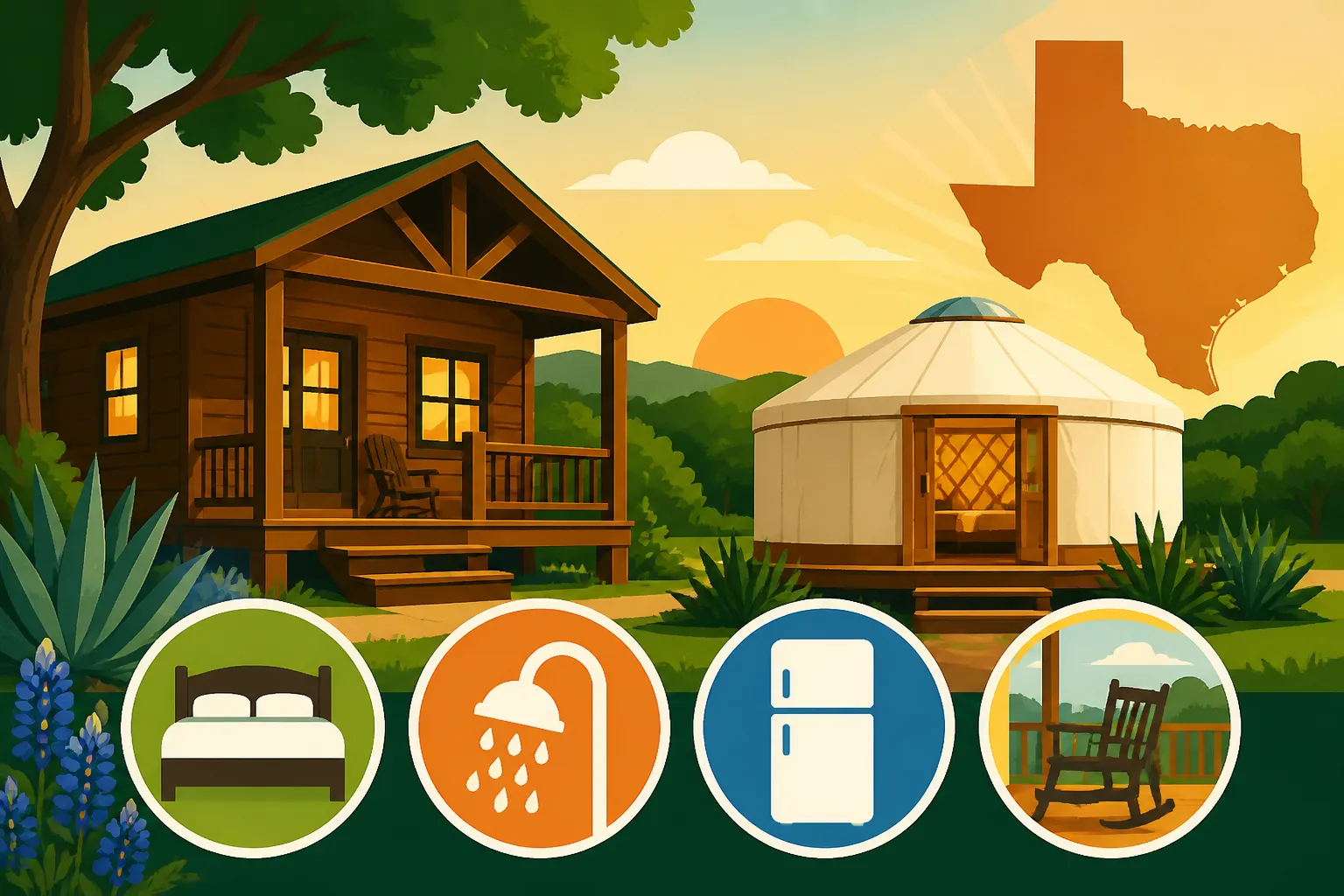
A Texas state park cabin or yurt can make an overnight trip easier, but the name alone doesn’t tell you what you’ll find inside. Bathrooms, bed linens, kitchens and nearby facilities can change what you need to pack. This guide explains what to check in the specific lodging listing, how to compare options and how to avoid arriving without something essential.
Start With the Listing, Not the Lodging Name
“Cabin” and “yurt” describe broad types of lodging, not a standard set of room features across Texas state parks. A booking title may tell you what kind of structure you’re reserving, but it isn’t a complete inventory of its amenities. Check the description for the specific unit and dates you’re considering before deciding what to bring.
That distinction matters most for basic comfort needs. A bathroom may be inside the cabin, or the listing may say the cabin does not have one. A kitchen may be included in a particular lodging option, but you should not assume that every cabin has one. The same caution applies to beds, linens, cookware, heating or cooling, and outdoor cooking equipment: look for a direct statement rather than inferring an item from a photo or from another park’s listing.
According to Texas Parks & Wildlife Department, cabins and group lodges have bathrooms. That general description is useful, but a specific listing still deserves a close read, especially when it describes a cabin as being without a bathroom. According to Texas Parks & Wildlife Department, cabins listed as being without bathrooms do not have bathrooms.
A useful way to compare options is to separate features into three categories:
| What you need to know | What to look for in the listing | Why it matters |
|---|---|---|
| Bathroom access | Whether the bathroom is inside the unit or the listing says there is no bathroom | Helps you decide whether the arrangement will work for your group and routine |
| Sleeping setup | The stated occupancy and any details about beds or sleeping space | Helps you judge whether everyone has a suitable place to sleep |
| Linens | Whether bed linens are supplied or guests must bring them | Prevents an avoidable packing gap |
| Food preparation | Whether the description specifies a kitchen or cooking facilities | Helps you plan meals and decide what equipment to bring |
| Fireplace | Whether one is included and what the listing says about related amenities | Avoids assuming that a fireplace means the same setup in every unit |
| Nearby facilities | Where the listing says restrooms or other shared facilities are located | Helps you understand what “nearby” means for your stay |
| Yurt features | The yurt’s own description, rather than a cabin description at the same park | Prevents transferring assumptions between lodging types |
Treat photos as a visual aid, not a complete specification. A picture might show a bed, table or kitchenette, but it may not make clear whether an item is included with the reservation, whether the picture shows the exact unit, or whether the image illustrates a different layout. If an amenity is essential, confirm it in the written listing or with the park through its official contact details.
The same approach applies when comparing two parks. Similar lodging names do not guarantee similar room contents. A cabin at one park may have a different bathroom arrangement from a cabin at another, and a yurt should be judged by its own description rather than by what a cabin nearby includes. For a closer look at the distinction, see Cabins With or Without Bathrooms: Check Before Booking.
Bathrooms and Nearby Restrooms
Bathroom access is one of the most consequential details to settle before booking. It affects how comfortable the stay may be for children, older relatives, anyone with mobility needs and anyone who prefers not to walk to a shared facility at night or in poor weather.
Read the bathroom wording literally. If the listing says a unit has a bathroom, that tells you the general arrangement, but it may not answer every practical question. Check the description for what is provided and whether it identifies the bathroom as private, shared or otherwise limited. Don’t assume a photograph shows all the features or fixtures. If a particular feature is necessary for your group, verify that exact detail with the park.
If the listing identifies a cabin as having no bathroom, plan around the facility it names. Texas Parks & Wildlife Department says, “Restrooms are usually in the area.” That gives a helpful general expectation, but it does not tell you the exact distance, route, accessibility or whether showers are available for every individual cabin. Look for those details on the specific park page, and ask the park if the arrangement would affect your plans.
Inks Lake State Park is a useful example of why that check matters. According to Texas Parks & Wildlife Department, Inks Lake State Park cabins do not have bathrooms, and restrooms with showers are nearby. If you’re considering one of those cabins, plan to use the nearby restrooms rather than expecting an in-room bathroom. The park-specific description is the detail to rely on for that stay.
When comparing a cabin with an in-room bathroom to one without, consider more than convenience in the abstract. Think about the needs of everyone who will use the lodging:
- Will anyone need easy access to a bathroom during the night?
- Would a walk to a shared restroom be difficult with a child, a mobility aid or a medical routine?
- Do you need a shower, or is a restroom without a shower sufficient?
- Would weather or darkness make a nearby facility less convenient?
- Does the listing give enough information to understand the route and facility arrangement?
If the description does not answer a question that could change your choice, don’t fill the gap with an assumption. Check the official park information or contact the park using current details from its official website. For more background on how to evaluate these options, see Cabins With Kitchens and Private Bathrooms in Texas State Parks and Accessibility at Texas State Parks: Campsites, Cabins and Restrooms.
Bathroom access is also worth confirming after you select a unit. If you change parks or switch to a different cabin type, revisit the listing instead of carrying over details from the first option. A park’s general cabin information may cover several units with different features, so the exact description remains important.
Beds, Sleeping Space and Bed Linens
A unit’s occupancy description and its sleeping arrangement are related, but they are not interchangeable. A stated capacity tells you whether your group may fit within the listed limit; it does not by itself explain which beds are present, how they are arranged or whether your group will find the arrangement comfortable. Check both the occupancy information and any description of the sleeping space.
According to Texas Parks & Wildlife Department, Inks Lake State Park cabins sleep four people. That is useful when comparing those cabins with your group’s needs, but it does not describe the bed layout. If bed type or arrangement matters, look for those details in the specific cabin information rather than assuming they are the same across the park.
Bed linens require a separate check. Texas Parks & Wildlife Department’s instruction is: You must bring your own bed linens; none are provided. Pack accordingly, and do not assume that a bed, mattress or other sleeping surface comes with sheets or blankets. The listing may tell you what sleeping furniture is present, while the linens requirement tells you what guests need to supply.
It can help to make a sleeping plan before you pack. Write down who will sleep where, then check whether the unit’s stated arrangement accommodates that plan. Consider whether anyone needs a particular kind of bed or extra room for medical equipment, a mobility aid or personal items. If your group includes children, ask whether the planned arrangement is comfortable and practical for them rather than relying only on the number of people allowed.
For a family or group comparing lodging, a cabin and a yurt should be treated as separate choices with separate sleeping descriptions. Avoid assuming that a yurt has the same beds, bedding, layout or capacity as a cabin in the same park. Use the exact unit description, and contact the park if it leaves an important sleeping detail unclear.
A packing list should reflect the published arrangement rather than what you hope will be there. Depending on what the listing confirms, you may need to bring sheets, blankets, pillows or other bedding. The key is to check what is included and what is not; the official listing may be more specific than the broad lodging category. For a fuller planning checklist, see First Night in a Texas State Park Cabin: A Packing List and Packing for a Yurt Stay at a Texas State Park.
Don’t overlook the practical space around the beds. A room can have enough sleeping capacity on paper but still feel crowded if your group has bulky bags, children’s gear or equipment that must stay close at hand. Look for layout information and photographs, then decide whether your packing plan is realistic for that space. If the listing does not explain the layout well enough, ask before you reserve.
Kitchens, Fireplaces and Meal Planning
A kitchen can change how you plan meals, but the word alone may not answer what cooking equipment or supplies are present. Look for an explicit description of the kitchen and any listed appliances or cookware. If the listing is silent about an item you need, assume it has not been confirmed and check with the park before depending on it.
The same applies to cookware and serving items. A kitchen does not automatically tell you whether pots, pans, dishes, utensils or food storage containers are supplied. Check the lodging description for each item that would affect your meal plan. If it is not listed, make a backup plan: bring what you need if allowed, choose meals that require less equipment, or confirm the available setup before the trip.
Fireplace cabins have a useful feature pairing to note. According to Texas Parks & Wildlife Department, cabins with fireplaces have kitchens and bathrooms. That information can help narrow your search if you want those features together, but it does not replace checking the individual listing for the details of the kitchen, fireplace or other amenities.
A fireplace is not a substitute for confirming how meals may be prepared. Read the park’s rules and the cabin information to understand what cooking arrangements are described. Don’t infer that a fireplace is intended for cooking, or that it comes with a grill or other equipment. If your meal plan depends on a particular cooking method, verify that it is permitted and available for the specific lodging option.
Before leaving home, turn the listing into a meal-preparation checklist:
- Identify the cooking facilities the description actually names.
- Check whether cookware and dishes are specified.
- Confirm whether you need to bring food-storage items.
- Choose meals that fit the confirmed setup.
- Pack any utensils or supplies that the listing does not say are provided.
- Check park rules for any cooking equipment you plan to bring or use.
This approach helps avoid two common mismatches: bringing unnecessary gear because you assumed the kitchen was bare, or arriving without essential equipment because you assumed it was stocked. If your meal plan depends on an appliance or cookware, verify it directly rather than relying on general descriptions. The article Linens and Cookware: What Texas State Park Lodging Doesn’t Supply can help you think through items to confirm before packing.
Food planning matters even when the kitchen details are clear. Consider whether you’ll prepare every meal at the lodging, eat outdoors, or bring food that needs little preparation. A simple menu can be more practical when equipment is uncertain. If the park listing describes a kitchen but does not name specific supplies, plan meals around the items you know you can bring and use.
Yurts and Cabins: Compare the Specific Room
A yurt may sound like an obvious alternative to a cabin, but the name does not establish what is inside. For a useful comparison, review the yurt description and the cabin description side by side. Record the features each listing actually states, then compare those features with your group’s priorities.
For example, if bathroom access matters most, compare the bathroom wording directly. If you need a kitchen, look for that feature in the individual listing rather than expecting it because another type of lodging at the park has one. If your main concern is sleeping, compare the stated occupancy and bed arrangement. If you need bed linens supplied, check that requirement separately.
A simple decision sheet can keep the comparison grounded:
| Your priority | Cabin listing | Yurt listing |
|---|---|---|
| Bathroom arrangement | Record the exact description | Record the exact description |
| Sleeping capacity | Note the stated capacity | Note the stated capacity |
| Beds and layout | Note what the listing confirms | Note what the listing confirms |
| Bed linens | Confirm whether you must bring them | Confirm whether you must bring them |
| Kitchen and cooking | List only the facilities named | List only the facilities named |
| Fireplace or other equipment | Check the unit description | Check the unit description |
| Nearby shared facilities | Note the details provided | Note the details provided |
The table is most useful when it records specific wording, not guesses. Avoid writing “probably has a kitchen” or “looks like it has a bathroom.” If the listing is unclear, mark the item as unconfirmed and ask the park. That keeps your choice based on actual information instead of a photograph or a general idea of what a cabin or yurt should include.
Your preference may also depend on how you’ll use the lodging. Someone who plans to spend most of the trip hiking may care most about a reliable sleeping setup and bathroom access. A group cooking meals at the unit may need detailed kitchen information. A guest with accessibility needs may need confirmation of the route, entry and bathroom arrangement. There isn’t one best option for every trip; the right fit is the unit whose confirmed features match your needs.
If you are comparing a cabin and yurt at the same park, check whether the listings describe the exact units or a broader category. A park page may include information that applies to some units but not others. Confirm the specific option you intend to reserve, and revisit the details if you change the unit later. For more help deciding between lodging styles, see Screened Shelter, Cabin or Yurt: Picking a Roof at a Texas State Park.
A Reliable Pre-Booking and Packing Check
Before choosing a lodging option, work through the details that are hardest to improvise after arrival. Start with bathroom access, sleeping capacity, bed arrangement and linens. Then verify the kitchen, cooking setup and any feature your group treats as essential. If the listing does not answer a key question, use the park’s official information or contact the park rather than relying on a general system-wide description.
A practical pre-booking process is:
- Open the official information for the park and the specific lodging option.
- Read the full description, not only the lodging name or short summary.
- Note the bathroom arrangement and any nearby restroom information.
- Record the stated capacity and sleeping details.
- Confirm whether bed linens are supplied or must be brought.
- Check what the listing says about a kitchen, fireplace and cooking equipment.
- Write down any unresolved questions and confirm them with the park.
- Build your packing list from the confirmed details.
After booking, check the description again before you pack. This is especially useful if you change lodging options, add someone to the group or make a meal plan that depends on a specific feature. Keep the confirmation details available so you can compare your reservation with the unit information and resolve any uncertainty before travel.
A useful packing list has two parts: confirmed needs and optional backups. Put required bedding and any unconfirmed kitchen items in the first group if you have decided to bring them. Keep optional items separate so you don’t overload the vehicle with equipment the lodging already provides. If the park confirms a feature is available, update the list; if it cannot confirm it, decide whether bringing a backup is worth the space.
Consider the trip from arrival through bedtime. Will you need to carry bedding from the vehicle? Is the route to a shared restroom workable for your group? Do you have food that can be prepared with the confirmed facilities? These questions can expose a mismatch before it becomes a problem at the cabin door.
If your plans depend on air-conditioning, heat or another comfort feature, check that exact item on the listing. Don’t infer it from the building type, season or photos. Checking for Air-Conditioning Before Booking a Park Cabin offers a focused checklist for that question. For rules that may affect what you bring or how you use a lodging unit, see Cabin House Rules in Texas State Parks: Pets, Tents and Smoking.
Finally, make sure everyone in your group understands what the lodging includes and what each person needs to bring. One shared packing list can prevent duplicated gear while also reducing the chance that the person responsible for bedding or food supplies assumes someone else packed them. Clear expectations are especially helpful when a group is dividing equipment between vehicles or arriving at different times.
Frequently Asked Questions
Do all Texas state park cabins have bathrooms?
No. Texas Parks & Wildlife Department distinguishes cabins with bathrooms from cabins listed as being without them. Read the description for the specific cabin before booking.
Are bed linens included?
Do not assume they are. Texas Parks & Wildlife Department says guests must bring their own bed linens for the cabins covered by its instruction, so check the lodging details and pack accordingly.
Do Texas state park yurts include kitchens?
The lodging name alone does not confirm a kitchen. Check the specific yurt listing for its kitchen and cooking details, and ask the park if an essential feature is unclear.
What should I check before choosing between an Inks Lake cabin and another lodging option?
Start with the bathroom arrangement, sleeping details and linens requirement. The Inks Lake cabin information says restrooms with showers are nearby, so consider whether that setup suits your group.
Sources
- Texas Parks & Wildlife Department — Lodging — Texas Parks & Wildlife Department (checked November 22, 2026)
- Texas Parks & Wildlife Department — Garner State Park Lodging — Texas Parks & Wildlife Department (checked November 23, 2026)
- Texas Parks & Wildlife Department — Inks Lake State Park Lodging — Texas Parks & Wildlife Department (checked November 23, 2026)
Disclaimer
This article is for general informational purposes only and does not constitute professional advice. Laws, prices and regulations vary by location and change over time. Consult a qualified professional for guidance on your specific situation. Texas Camping & RV is not a government agency and is not affiliated with any government agency.