Bad Weather at Texas State Parks: Closures, Heat and Hike-In Sites
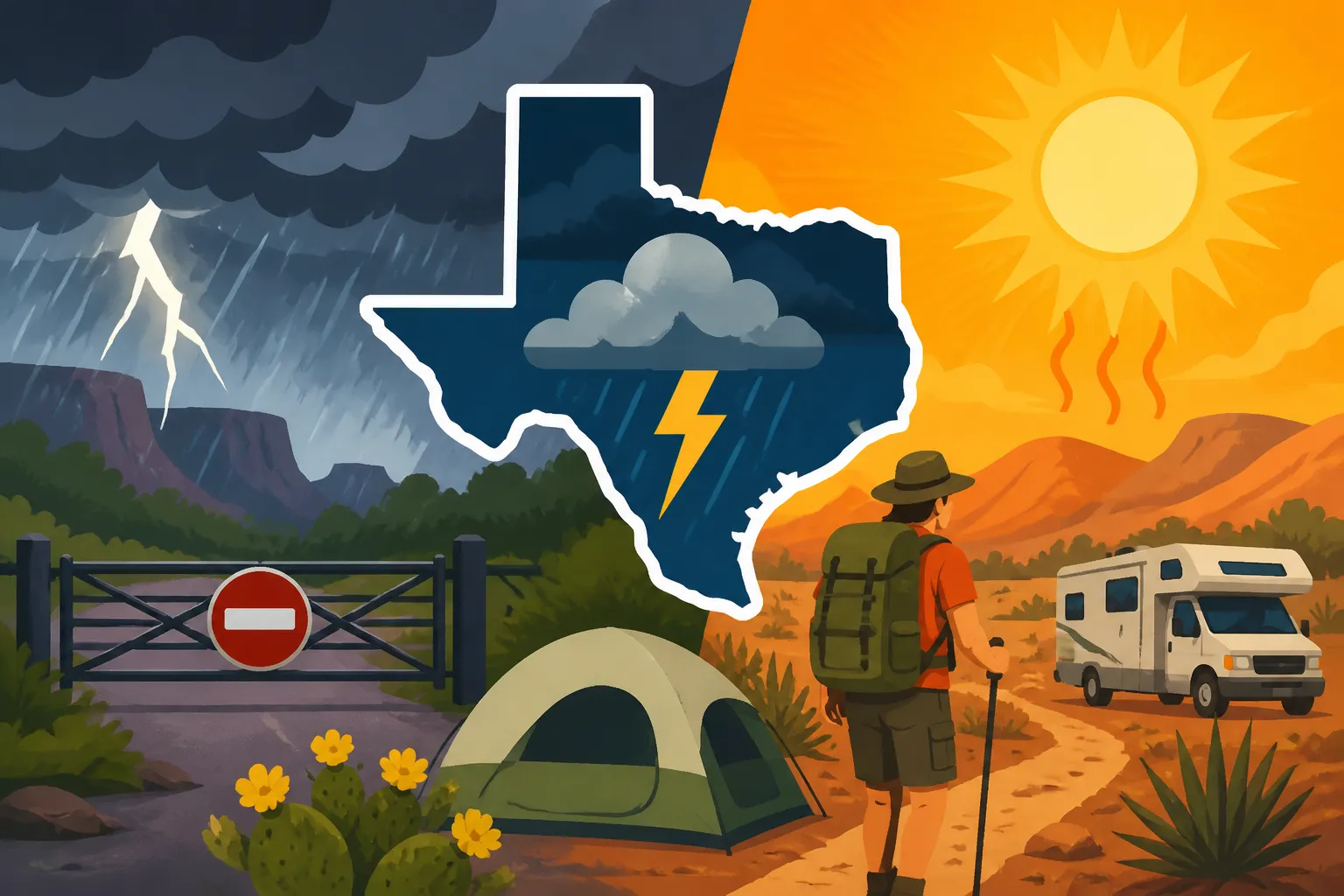
Bad weather can change more than the comfort of a Texas State Park trip: it can affect trail access, backcountry campsites, water needs and whether a hike-in plan still makes sense. The useful question is not simply whether rain or heat is forecast, but what conditions mean for your specific park and site. Here’s how to check, adjust your plans and decide when to change course.
What bad weather can change at a Texas State Park
Weather affects a trip in different ways depending on where you plan to go and what you plan to do. A shower might call for a change of clothing and a backup activity; wet conditions can make some trails or backcountry areas unsuitable. Heat can affect how much water and shade your group needs. A closure may make a booked or planned activity unavailable, even if other parts of the park remain accessible.
The key is to avoid treating a park as one all-or-nothing destination. A campsite, trail, road, swimming area or visitor facility can each have different conditions and access. Confirm the status of the places you actually intend to use, rather than assuming that an open gate means every activity is available.
Texas Parks & Wildlife Department says Sites may be closed due to weather conditions. That statement is a useful reminder for anyone planning a hike-in stay: a reservation or a familiar route does not guarantee that a site will be usable under changing conditions. Check the current status before setting out, and be prepared to change the itinerary if a closure affects your plan.
Closures can also be about protecting an area, not only keeping visitors away from uncomfortable conditions. Texas Parks & Wildlife Department notes that trails and backcountry campsites may be closed to protect sensitive areas or for bad weather. Observe closure signs on the ground, even if a trail or campsite appears passable. A route that looks manageable from the entrance may still be closed for reasons that are not obvious to a visitor.
That means a sound plan has two parts:
- A primary plan: the site, trail or activity you most want to use.
- A workable alternative: a different activity, campsite type or destination that does not depend on the same access or conditions.
If you are still deciding what kind of overnight stay fits your group, Choosing a Texas State Park Campsite: Drive-Up, Walk-In or Hike-In can help you compare the practical differences. For a wider overview of closures and weather planning, see Bad Weather at Texas State Parks: Closures, Heat and Hike-In Sites only if it is not the current article; instead, use Park Alerts and Closures: Checking Before You Leave Home and Researching a Texas State Park Trip: Park Pages, Maps and Alerts.
Check current conditions before you drive
A forecast is useful, but it cannot tell you by itself whether your intended trail, primitive site or access road is open. Conditions can change, and a forecast may not describe what is happening at a particular campsite or trail. For that reason, use the forecast as one input and the park’s current information as another.
Texas Parks & Wildlife Department advises visitors to call before you come for current information. That is particularly relevant when your plan depends on a hike-in site, a backcountry campsite or a trail that might be affected by recent weather. Check the park’s official information before departure, and make direct contact when you need clarification about a specific route or site.
A practical pre-trip check can follow this order:
- Read the park’s current alerts and notices. Look for closures, access changes and weather-related updates that affect your planned area.
- Check your planned trail and campsite specifically. A general park status may not answer whether a particular route or primitive site is accessible.
- Call before leaving if the information is unclear. Ask about the exact destination and conditions relevant to your plan.
- Recheck close to departure. An earlier update may not reflect a later change in weather or access.
- Save the information you may need offline. Download a park map and note your alternate plan before you reach an area with limited signal.
For more on how to interpret park pages, maps and notices, see Researching a Texas State Park Trip: Park Pages, Maps and Alerts. Downloading a Park Map Before Losing Signal at a Texas State Park is also useful when you expect weak or unavailable cell service.
When you check, be specific. Instead of asking only whether the park is open, ask whether the trail or campsite you intend to use is open, whether the route to it is affected, and whether there are other restrictions or changes to know about. If you are driving an RV or towing a trailer, include access and parking in your questions; a route that is appropriate for one vehicle may not suit another.
Do not rely on an old social post, a third-party map or a saved screenshot as the final word on a closure. Those tools may help you prepare, but current park information is the better place to confirm changes. For a broader checklist of information to verify before setting out, see Before You Arrive: Details to Confirm on a Texas Campsite Booking.
Rain, wet trails and hike-in campsites
Rain can make a hike-in plan more complicated even when the trip remains possible. The approach may be muddy, a low spot may hold water, or a route may become difficult to follow. The conditions may also make a site less suitable for camping. Do not assume a route is safe or open merely because it was usable on a previous visit.
Texas Parks & Wildlife Department states that trails and backcountry campsites may close due to wet conditions or poor weather. If a closure applies, follow it rather than trying to find a way around it. A closed route can include hazards that are not easy to judge from a distance, and walking around a sign can also take you into an area that is not open to visitors.
Wet weather creates practical issues even when there is no closure. Before leaving, consider how rain would affect each part of the trip:
- The approach: Could wet ground make the route difficult for your group or gear?
- The campsite: Is there a sheltered place for your equipment, and can you keep sleeping gear dry?
- The return: Would rain make the route harder to follow or slow the walk out?
- The backup: Can you switch to a drive-up campsite, cabin or day visit if the hike-in plan no longer makes sense?
For gear planning, separate what needs to stay dry from what can tolerate getting damp. Keep sleeping layers and critical supplies in waterproof protection, and avoid depending on one bag or one container to protect everything. Pack a way to change into dry clothing when conditions warrant, and keep wet footwear from soaking the items you need at camp.
A hike-in site also changes how much equipment you can reasonably carry. If the weather forecast suggests a heavier or more complicated load, consider whether the added gear makes the route realistic for everyone in your party. The question is not just whether you can carry it at the start; it is whether you can manage it if the trail is wet, the pace slows or you need to turn back.
If the park closes the site or trail, treat the closure as a change to the trip rather than a challenge to overcome. Ask the park about available alternatives, if you need one. If no suitable option is open, move the trip to another date or choose a different destination. A backup should be genuinely usable, not a vague hope that conditions will improve after you arrive.
For trips where the hike itself is central, Why Hike-In Campers Must Reach the Park Before Dusk for a Permit and Do Texas State Park Hike-In Campsites Have Water or Restrooms? can help you think through logistics that matter before the weather complicates the plan. Check the specific park’s information for the details that apply to your route and site.
Heat, shade and water planning
Hot weather can turn an ordinary day outside into a demanding one, especially when a route has limited shade or your group is carrying equipment. Plan around the conditions you expect, not only around the activity you hope to complete. A short outing can still feel strenuous if it takes place in direct sun, and a campsite can be uncomfortable if your group has no realistic way to cool down.
At Colorado Bend State Park, Texas Parks & Wildlife Department recommends carrying one liter of water per person per hour of activity, including for pets. Use that park-specific guidance as a reminder to plan water deliberately, while checking the official information for the location where you intend to visit. Water needs vary with the activity and conditions, so do not assume that a single amount will suit every person or every trip.
Think about water for the whole outing, not just the walk. That includes the time needed to reach a trail, time spent outside, the return, and any delay caused by a changed route or slower pace. If you bring a pet, include the animal in your planning. Do not assume there will be a refill point where you need one; confirm available water information for the specific area and carry what your plan requires.
Heat planning also involves timing and pace. Consider whether an exposed walk is still a good fit for your group under the forecast. A strenuous route may be better replaced with a shorter outing, a shaded activity or a visit at a more suitable time. If someone in your group begins to feel unwell, stop the activity and prioritize getting to a safer, cooler place. Do not let a planned distance or schedule become a reason to continue when conditions are becoming a problem.
Useful adjustments include:
- Choose a shorter or less exposed activity if the forecast makes the original route a poor fit.
- Carry water in a way that is easy to reach while walking.
- Take breaks before anyone feels exhausted, and use shade when it is available.
- Keep pets’ water needs in mind instead of assuming they can manage on what the people carry.
- Leave room in the schedule to slow down or end the outing early.
A campsite with shade may make a hot stay more manageable, but shade is not guaranteed just because a site is outdoors. Check photos, maps and the campsite description, and look for details that apply to the specific site. Does Your Texas State Park Campsite Have Shade in Summer? explains why it is worth confirming this before booking. If the main goal is a day visit rather than an overnight stay, Packing a Day Bag for a Hot Texas State Park Visit can help you organize essentials.
Heat can also affect your sleep and recovery. A poor night can make the following day’s hike feel harder, so consider whether a tent, screened shelter, cabin or other accommodation best suits your group and the conditions. For a comparison of overnight choices, see Screened Shelter or Tent Site on a Hot Texas Weekend?. Make sure you verify what the specific site provides; do not assume that a roof, shade or nearby water is included unless the park’s listing confirms it.
Choosing a campsite that fits uncertain weather
The best campsite for a bad-weather trip is not always the one with the most appealing view. It is the option that suits your group’s needs while leaving room to adjust. A hike-in site may be a rewarding choice when the route and conditions work for your party, but it gives you fewer easy options if weather or access changes. A drive-up site, screened shelter or cabin may offer a more practical alternative for some groups.
Start by identifying what your trip depends on. If you need a particular trail to reach the campsite, then trail access is central to the plan. If you are relying on a water source, verify its availability for the site rather than inferring it from a map. If your group includes people who would struggle with a long or wet approach, factor that into the decision before booking.
A simple comparison can help:
| Trip option | What to consider in unsettled weather | A practical backup |
|---|---|---|
| Hike-in primitive campsite | Route condition, closure notices, carried supplies and the ability to turn back | A drive-up site, different activity or changed trip date |
| Drive-up campsite | Access, site conditions, shade and the facilities listed for that site | Another open campsite or an earlier departure |
| Screened shelter | What is enclosed, what remains exposed and what gear you still need | A suitable cabin or a revised packing plan |
| Cabin | What the room includes, access conditions and rules for the accommodation | A campsite or a different travel date |
| Day visit | Day-use access, heat, rain exposure and whether your planned area is open | A shorter visit or another park activity |
This comparison is a planning tool, not a claim that any particular option is available at every park. Site descriptions and rules differ. Check what your chosen park offers and what is included before deciding. Camping in Texas State Parks: Tent Pads, Hookup Sites and Cabins offers a broader look at accommodation types, while Cabins and Yurts in Texas State Parks: What the Rooms Include helps set expectations for indoor stays.
If you are comparing a tent site with a roofed option, be clear about what a roof does and does not solve. A screened shelter can protect some belongings from direct rain, but it is not necessarily a fully enclosed room. A cabin may reduce exposure to weather, but it does not make access roads or nearby trails immune to closures. The right fit depends on the site details, your group and the conditions.
It is also sensible to avoid building a trip around a single activity that has no alternative. If the main trail closes, can your group still enjoy the stay? If rain makes the hike-in approach unsuitable, can you switch to another type of site? If the answer is no, a different park or date may be the better choice.
Make a decision when conditions change
A good weather plan includes a point at which you are willing to change course. That decision is easier before you are tired, wet or already committed to a difficult route. Agree as a group on what information would lead you to postpone, choose another site or skip an activity.
Use current park information first. If an area is listed as closed, do not proceed into it. If the status is unclear, contact the park before you leave. Texas Parks & Wildlife Department advises visitors to call before you come for current information, a particularly useful step when your trip depends on a specific backcountry campsite or trail.
When a change is needed, work through the choices in a practical order:
- Keep the trip, change the activity. Use an alternative that does not depend on the closed or unsuitable area.
- Keep the destination, change the accommodation. If a hike-in site no longer works, check whether another site type is available and suitable.
- Change the destination. Do this only after verifying the other park’s current conditions and access.
- Postpone. If the weather or closure removes the main purpose of the trip, rescheduling may be safer and simpler.
Do not treat a reservation as a reason to press ahead when the plan no longer fits the conditions. Check the booking terms and contact the appropriate park or reservation service if you need to understand what options apply to your booking. The availability of a different site or a change to a reservation depends on the details of the booking and the park; confirm them with the official source.
During the trip, continue to notice what is happening around you. Rain may increase, surfaces may become slippery, and heat may feel more intense than expected. Closure signs take priority over a map or an earlier plan. If a route looks substantially different from what you expected, pause rather than trying to improvise a way through.
For more planning around rain-related changes, see Can Heavy Rain Close Trails and Campsites at Texas State Parks? and Rainy Weekend at a Texas State Park: Backup Plans. If thunderstorms are the concern, Thunderstorms During a Texas State Park Camping Trip provides another angle on preparing for a change in conditions.
A practical before-you-go and on-site checklist
Weather preparation is most effective when the details are written down and easy to use. A plan that exists only in someone’s memory can disappear when a group is packing, driving or responding to a late change. Keep the essentials together: the park information, a map, the route, the relevant closure check and the alternative.
Before departure:
- Confirm the status of the specific campsite, trail and route you plan to use.
- Check official park updates and contact the park if anything is unclear.
- Review the forecast for the travel period and the activities you intend to do.
- Decide what conditions would make you switch to the backup plan.
- Confirm what your campsite or accommodation provides, including water information where relevant.
- Pack to protect essential items from rain and to support the water and shade needs of the group.
- Download the park map and save key information where it can be reached without a signal.
- Tell everyone in the group what the backup plan is and who will make the call to change it.
After arrival:
- Read any closure notices and follow signs on the ground.
- Check whether the route and site still match the information you confirmed.
- Keep water accessible and adjust activity if heat, pace or conditions call for it.
- Reconsider the hike-in plan if the approach is wet, difficult or officially closed.
- Use the backup plan rather than trying to force the original itinerary.
A useful rule of thumb is to make the plan fit the least flexible person in your group, not just the strongest or most experienced participant. That may mean choosing a shorter route, carrying less gear by selecting a drive-up site, or making the trip a day visit rather than an overnight hike. A flexible itinerary is not a lesser trip; it is a way to keep the experience workable when weather changes.
For park-specific information, start with the official park page and alerts, then contact the park when a detail is uncertain. The safest plan is one that reflects the current condition of the place you intend to visit, leaves room to change activities and treats closures as a firm boundary.
Frequently Asked Questions
Can a Texas State Park close a hike-in campsite because of weather?
Yes. Texas Parks & Wildlife Department says sites may be closed due to weather conditions. Check the specific site’s current status before you leave and follow any closure notices.
Should I still hike to a backcountry campsite if the route looks passable?
Not if the park has closed the route or site. Texas Parks & Wildlife Department says trails and backcountry campsites may close for bad weather or to protect sensitive areas. Observe closure signs and confirm uncertain conditions with the park.
How much water should I bring in hot weather?
Water needs depend on the park, activity and conditions. For Colorado Bend State Park, Texas Parks & Wildlife Department recommends carrying one liter of water per person per hour of activity, including for pets. Check the official information for your destination and plan for your group’s needs.
Is a drive-up campsite always a better choice in bad weather?
Not necessarily. A drive-up site may avoid a hike-in approach, but you still need to confirm that the site and access are available and suitable. Compare the actual site details with your group’s needs and keep another option in mind.
Sources
- Texas Parks & Wildlife Department — Palo Duro Canyon State Park Campsites — Texas Parks & Wildlife Department (checked November 23, 2026)
- Texas Parks & Wildlife Department — Hill Country State Natural Area Campsites — Texas Parks & Wildlife Department (checked November 23, 2026)
- Texas Parks & Wildlife Department — Hill Country State Natural Area — Texas Parks & Wildlife Department (checked November 23, 2026)
- Texas Parks & Wildlife Department — Search State Parks — Texas Parks & Wildlife Department (checked November 22, 2026)
Disclaimer
This article is for general informational purposes only and does not constitute professional advice. Laws, prices and regulations vary by location and change over time. Consult a qualified professional for guidance on your specific situation. Texas Camping & RV is not a government agency and is not affiliated with any government agency.